
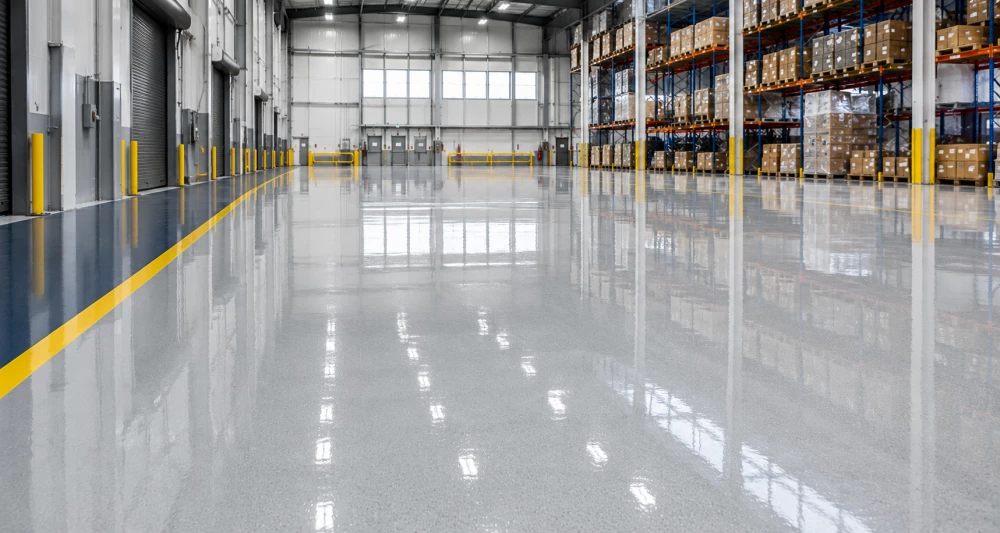
Warehouse Floor Coatings in Sale
Get in TouchWarehouse floor coatings can transform an exposed or previously coated concrete floor into a finished surface suited to the day-to-day operation of the facility.
We install warehouse floor coatings in Sale for storage facilities, distribution centres and logistics buildings. Systems are selected according to the existing concrete, warehouse traffic and conditions within each area.
Warehouse Epoxy Floor Coatings Sale
Epoxy coatings are commonly used on internal concrete warehouse floors.
Once the substrate has been suitably prepared, the coating forms a continuous finish across the surface.
Warehouse epoxy coatings can be considered for:
Storage areas
Racking aisles
Picking and packing zones
Goods-in areas
Dispatch areas
Pedestrian routes
Internal forklift routes
General operational floors
Different coating systems provide different levels of build and performance, so the expected use of the floor should influence the specification.
What Does a Warehouse Floor Coating Do?
A floor coating creates a finished layer over the underlying concrete.
Depending on the selected system, it can provide a more uniform and maintainable surface while also allowing colours, textures and operational markings to be incorporated.
The coating does not replace the structural function of the concrete slab beneath it.
Cracks, damaged joints, potholes and weak concrete may therefore need separate attention before coating work begins.
Coating Floors Used by Forklifts
Forklift traffic rarely affects a warehouse floor evenly.
Vehicles tend to follow the same routes throughout each shift, creating concentrated use around aisles, doorways, intersections and loading areas.
A coating for these sections should be selected around factors such as:
Forklift type
Wheel type
Vehicle movements
Turning frequency
Pallet truck traffic
Mechanical wear
Existing floor condition
More intensive operating conditions can require a heavier-duty system than areas primarily used for static storage.
Request a Warehouse Coating Quote
High-Build Epoxy Floor Coatings
High-build epoxy systems provide a greater coating thickness than straightforward floor paints.
They can be used where a warehouse requires a more substantial resin finish while remaining within a coating-based system.
Potential applications include busy aisles, picking areas, packing zones and other operational sections.
The required system should still be based on the demands of the individual warehouse rather than assuming a high-build coating is suitable for every heavy-duty environment.
Warehouse Floor Paint or Resin Coating?
Warehouse floor paint and resin flooring are sometimes treated as interchangeable terms, but the products available can vary considerably in build and intended use.
A basic floor paint may be sufficient for some lightly used areas.
Busier operational environments can require a more substantial epoxy or resin coating system.
For particularly demanding floors, a heavier-duty resin flooring specification may be more appropriate than a coating.
The decision should be based on the substrate and expected traffic rather than appearance alone.
Preparing Concrete for a Floor Coating Sale
Preparation is essential before applying a warehouse floor coating.
The new system needs an appropriate surface to bond to.
Depending on the condition of the concrete, preparation may involve:
Inspecting the existing floor
Removing contamination
Mechanically preparing the surface
Removing loose or failed coatings
Repairing local concrete damage
Addressing cracks and damaged joints where required
Preparing repaired areas
Applying the specified coating system
Grinding or shot blasting may be used where appropriate to mechanically prepare the concrete.
Recoating Old Warehouse Floors
Existing coatings can become worn after years of warehouse use.
Main traffic routes may show significantly greater deterioration than sections beneath racking or within low-traffic storage areas.
Recoating can be considered where the underlying floor remains suitable.
Existing finishes should first be checked for adhesion and condition. Poorly bonded or failed material may need to be removed rather than encapsulated beneath another coating.
Removing Failed Floor Coatings
Peeling, flaking and delaminated coatings provide an unsuitable base for a new flooring system.
Mechanical preparation can be used to remove failed material and expose the substrate below.
This process can also reveal problems that were previously hidden by the existing finish, including cracks, damaged concrete and previous repairs.
These areas can then be assessed before the new coating is installed.
Coloured Warehouse Coatings
Colour can be incorporated into a warehouse flooring scheme to distinguish different areas of the facility.
For example, separate colours can identify operational zones, storage sections or pedestrian areas.
Contrasting line markings can then be applied over or alongside the main floor finish.
Using colour in this way connects the flooring finish with the wider organisation of the warehouse.
Slip-Resistant Warehouse Floor Coatings Sale
The appropriate surface texture depends on the conditions expected within the area.
Water, oils and other contaminants can reduce grip and increase slip risk.
Where contamination is foreseeable, a coating incorporating additional texture can be considered.
This may be relevant around loading areas, entrances, ramps and other sections where contamination is more likely.
Greater texture can also affect cleaning, so slip resistance and maintainability should be considered together when selecting the finish.
Floor Coatings for Loading Areas
Goods-in and dispatch sections can experience a combination of concentrated traffic and contamination.
Forklifts repeatedly travel between storage areas and loading points while water and dirt can be transferred inside from external areas.
A coating in these locations should therefore be considered around both mechanical use and the conditions likely to develop on the surface.
Any damaged concrete or joints should also be addressed where necessary before coating.
Warehouse Floor Coating and Line Marking
A coating project can provide an opportunity to reorganise the visual layout of a warehouse.
Once the main flooring system has been completed, line markings can identify:
Forklift routes
Pedestrian walkways
Crossing points
Storage bays
Racking aisles
Keep-clear zones
Loading areas
Work zones
Floor markings should support the site's wider traffic-management arrangements.
Coating Different Areas of a Warehouse
One coating specification does not necessarily need to be used throughout the entire building.
The warehouse can instead be divided according to use.
Low-Traffic Storage Areas
A comparatively straightforward coating may be appropriate where the floor experiences limited vehicle movement.
Main Warehouse Aisles
More frequent forklift and pallet truck traffic can require a more durable specification.
Picking and Packing Areas
The coating can be selected around pedestrian movement, trolleys and operational equipment.
Loading Areas
Traffic, contamination and slip risk become more significant considerations.
Assessing these areas independently allows the flooring specification to reflect how the warehouse actually operates.
Warehouse Floor Coating Refurbishment Sale
Floor coating projects can be completed as part of a wider warehouse refurbishment or as a standalone flooring upgrade.
Where operations need to continue, installation may be divided into sections.
Stock and traffic can be redirected while an area is prepared, coated and allowed to cure.
The completed section should only be returned to service when the selected system has reached the required stage for the expected traffic.
Get a Warehouse Floor Coating Quote
Warehouse Floor Coating Installers Sale
We install epoxy and resin warehouse floor coatings throughout Sale for storage facilities, logistics buildings and distribution centres.
Projects can include new coatings, recoating existing floors, mechanical preparation, failed coating removal, local repairs, textured finishes and line marking.
Send us photographs of the existing concrete, the approximate floor area and information about forklift or pallet truck traffic. We can then establish the likely preparation and coating requirements for the warehouse.
We cover Sale (Greater Manchester)